DakPro
Week 6
Happy Linux birthday! (25 Aug)
Happy Ukraine independence day! (24 Aug)
Happy Ukrainian Flag day! (23 Aug)
Difference between Whisper and Moonshine
Due to it’s architecture and training, Whisper accepts only chunks of 30s. Thus when you try real-time speech recognition, for instance so that chunks of 2s are processed at once, it automatically appends 28s of zeroes. As a result you have to perform computation as of 30s on 2s chunk.
Both Whisper and moonshine are encoder-decoder transformers. Their simplified structure:
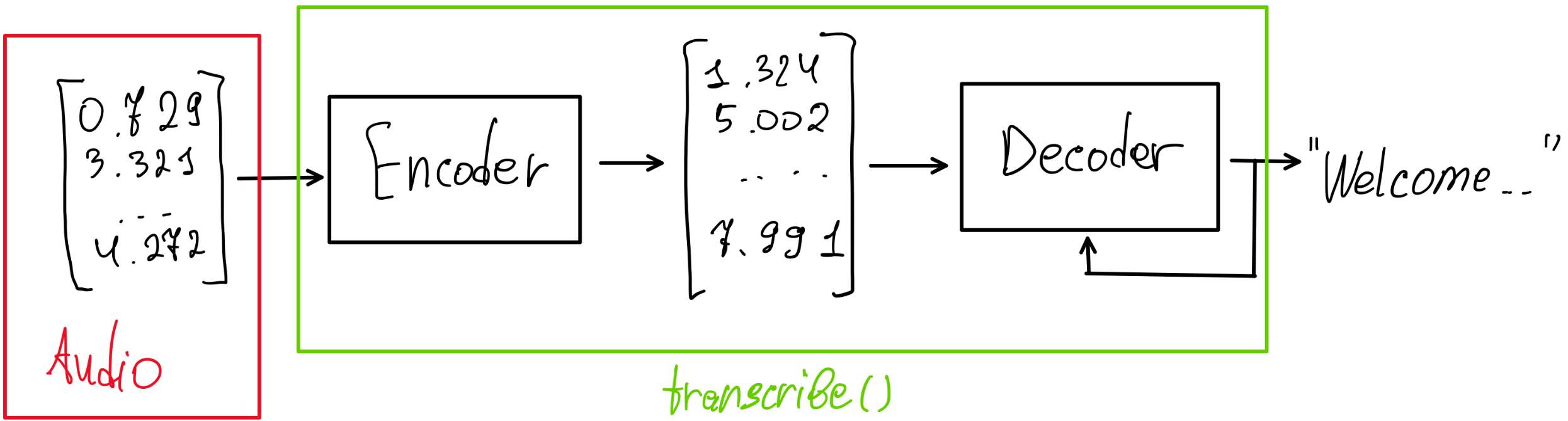 In Whisper, vector passed into an encoder must always correspond to 30s audio (otherwise WER signifficantly increases).
Key difference in Moonshine is that it has type of encoder that uses Rotary Position Embeddings, so it handles inputs of varied lengths (and thus is trained on such).
Though moonshine is much faster for streaming, its largest currently awailable model(base) has RTF~=0.3. If a whisper model has higher WER but still can transcribe 30s chunks in less than 30s, one could use whisper during meetings(where low latency is not required) for better better transcriptions
Updates on pipeline
- Extended evaluation script: now it accepts more models using regex. (useful for e.g. quantization, model finetunings)
- New metric: RTF (real-time factor = transcription time / audio length) - evaluates RTF on a given audio chunk. Note: many models have different RTFs depending on the audio length.
- Optimized moonshine/file_trans so it doesn’t reload model/tokenizer every time an audio is called (useful for evaluation).
- Added Vosk. It’s used as a library, so its pipeline is quite trivial. Key differences between Vosk and models considered before:
- Vosk uses Neural Networks and Hidden Markov Models instead of encoder
- Vosk outputs are lowercase and exclude punctuation
Table of evaluated models
RTF - Real-Time Factor = transcription time / audio length.
sRTF - Streaming Real-Time Factor = transcription time / speech length.
UPL - User Perceived Latency, or latency = average time it takes for a spoken word to get displayed. For models with segmental transcription, the result for the start of a segment is taken.
| Model | sRTF on rPi 4 | RTF on rPi 4 | UPL*, seconds |
|---|---|---|---|
| Moonshine (base) | 0.28-0.35 (1) | 0.64 | 0.2 + 0.2×RTF |
| Whisper.cpp (tiny) | 30xRTF/X ** | 0.39 (2) | X + 30×RTF |
| Whisper.cpp (base) | same as above | 0.74 (2) | same as above |
| Whisper.cpp (small) | same as above | 2.44 (2) | same as above |
| Kuytai | >1 | 10 | not feasible |
UPL* - listed UPLs are theoretical and valid only if RTF on device is < 1. Formulas for values are given using standard configuration of models (read below for more details).
** - streaming on whisper model works by recording audio for X (default: 0.5) seconds and then transcribing it. The architecture transcribes audio in 30 s chunks only, thus sRTF depends on X. In combination with UPL explanation, X just defines balance between UPL and sRTF.
(1) - Lower RTFs were observed on more consistent/faster speeches. (2) - RTF for whisper depends on length of an audio being transcribed. The RTF evaluation is done on 90s audio sample, as due to “30s-input-only” architecture constraint whisper gives highest RTFs on audios with length divisible by 30.